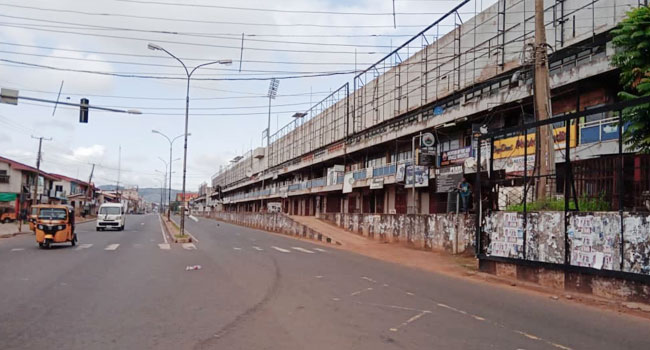


Chaos, fear, and anxiety ruled the streets of Enugu between the hours of eight and eleven, today, Wednesday, July 5, 2023.
Weirdly dressed men, all wielding guns of various types, had stormed parts of Abakpa, GRA, Coal Camp, New Market and old Park, shouting and threatening to kill if people did not run away to observed the Simon-Ekpa declared week-long lockdown.
Eye witness accounts at Abakpa said that most traders at the community market had just settled down for the business of the day when, suddenly, the gun men clad in black trousers and vests, covered with red flowing gowns, appeared from nowhere and started firing guns in various directions.
They were said to be screaming, "you no hear say sit-at-home dey...what are you doing here?.
They fired their smoking guns in the air, and some aimed at objects on the ground.
Another observer said that the moment their presence was registered, traders and their customers scampered in various directions, screaming and pleading to he spared.
The gun men were said to have quickly embarked on upturning of the many baskets of farm produces already arranged for the day's sales. They were said to have jumped on some of these baskets of corns, onions, pepper, ocra oranges, and other fruits, crushing them just to ensure that they were rendered useless.
Others said that they had left within 20 minutes of their arrival, but had left in their trails destroyed market wares, farm produces and limping men and women who had suffered fracture in the ensuing melee.
At the popular old IMT bus stop opposite Shoprite, at GRA, the armed had arrived about 9.10am and had chased a blue SUV which they stopped and ordered the driver to open his door. The man was said to have quickly complied as he was soon forced to lie on the ground, his belle as he was being beaten.
Bystanders, mostly street traders, commuters and traders had scampered for safety.
The panic was so intense that travelers were jumping from moving vehicles to wherever they considered safe.
One lady who leapt out of her car and fell as she tried to make a dash later told this reporter that she had just gone to drop off her children at school.
She only wanted to get to the shoprite back junction to pick some stuff for her husband but was caught in the commotion.
She said that she almost broke her leg as she made the jump.
According to her, it was at that point that she quickly rolled into the nearby gutter for safety.
A while later, she recounted, an "army armoured car (this reporter confirmed it to be an armoured personnel career, APC), appeared from the direction of Ogui Junction," seeming in hint pursuit.
Another bystander, who said he observed every bit of what happened, said that "the army tank did not meet them. They had finished and headed to the New Market side through the Abakaliki Road/All Saints Church when the soldiers arrived.
"We tried to shout out to the soldiers to tell them where they had gone, but the tank was going too fast."
Asked if he knew whether the tank headed in the same direction of the gunmen, he said no. "The soldiers headed to the old Park side through Okpara Avenue."
According to him, even if the soldiers had arrived on time to engage the armed men, it would have been catastrophic as there were too many people, most of whom were utterly confused and running helter-skelter.
In his words, "the soldiers would have killed a lot of innocent people if they had opened fire there."
At New Market, the armed men were said to have zoomed in at the Onitsha road/Works Road junction and fired repeatedly in the air. People scampered, abandoning their shops, wares and whatever they were doing.
A hair dresser was seen later making calls to ask her customers who left their daughters in her shop, where she was to plait their hairs, to come over to her home at Ogui Township, to pick their child.
She said that nothing would make her to spend any additional minute in the market. In minutes, she set off on foot.
At Ngenevu, a tough neighbourhood in the century-old Coal Camp, a video clip making the rounds showed a sit-at-home enforcer methodically destroying farm produces, including ocra, corn, pepper, etc. The owners had already fled and possibly escaped being hurt.
Since yesterday, some video clips had been circulating, where the same kind of ruthless enforcement of the sit-at-home in Ebonyi State had taken place.
At a place identified as Isieke junction market, the enforcers had burnt at least on tricycle, a.k.a Keke. They also visibly shot two commercial motorcyclists - okada riders - possibly wounding or killing them.
The obviously, barely educated, leader, yelled that the sit-at-home must continue and be enforced. He admonished his men to "burn everything," because, according to him, "no release of Nnamdi Kanu, no peace in Biafra land...we say, stay in your house...don't come out."
Recently, the newly inaugurated government of Enugu State had expressed its displeasure at the continuing of the now two-year old sit-at-home exercises and demanded that it be stopped.
The government had followed this with the directives for people to go about their normal activities in total disregard to the orders of the Finland based Simon Ekpa and his cohorts. It assured the people that it had taken the necessary measures to ensure the safety of all.
Government was actually reported to have taken steps, including activating the security architecture in the State to ensure that sufficient safe guard measures were put in place. Even the police had issued a series of statements assuring people of their safety if only they would move around and do their businesses.
In effect, the exercise, now deemed as injurious to the economy of the South East began to slack.
People commenced moving around, doing their businesses.
Ekpa was later reported to have vowed to teach people a lesson for disobeying his orders issued from Finland.
He soon announced a week-long - July 3 - 10, 2023 - sit-at-home,leaving just one day, tomorrow the 6th of July, as a breather for the heavily punished people. This particular regime of week-long sit-at-home started on Monday, July 3, and has been ongoing.
For some time now, people and even political analysts have wondered about the true objectives of the planners of the crushing exercise.
The South East, SE, of Nigeria is a region with little or no organised businesses. They are mostly civil servants.
The others are mostly of the small time and petty trading cadres of businesses. More than 45 percent of the traders actually operate on the so called "below-250-Dollar-business bracket" margin. The effect of this is that majority of them must operate every day to be able to feed their families.
Another class of other businesses above this margin may not feel the immediate blows of not doing businesses in two or three days, but very few can actually sustain such prevailing and pervading hiccups as Monday sit-at-home and now week-long lockdown.
Since the end of the 1967 - 1970 war in Nigeria, the Region has suffered untellable blight in the areas of infrastructure development and maintenance. The heavy industries such as Niger Gas, Niger Asbestos, NigerCem, Abatex, etc, erected by the Nnamdi Azikiwe and Micheal Okpara administrations were all abandoned or mismanaged to ruination.
The few established by the Jim Nwobodo and Sam Mbakwe administrations, have equally been ruined, through mismanagent and obsolensce of fittings.
At the moment, strong questions have arisen of the real intentions of the organisers and enforcers of sit-at-home. The openly stated reasons are the demand for release of Nnamdi Kanu and conduct of referendum to determine the would be status of some areas of Nigeria, especially in the South East.
Indeed, the courts in Nigeria have long ruled against further detention of Kanu, opinning that his arrest, in the first place, was illegal and in complete violation of international laws.
On the deamded referendum, watchers argue that it had become obvious that the agitators have had no idea what would bring about referendum. Some however reason that they know but opted to pursue what is called 'mix-of-declarative-and-constitutive options in self determination struggles.
Of course, theories in self determination have identified the "unilaterally declarative" self determination and "constitutive self determination," as the most popular of self determination incidences in the world.
In declarative option, the agitators take laws into their hands and assert their independence, whatever the outcome.
The usual outcome is war, fighting and victory or defeat. Few new States have succeeded in this. In Africa, only Eritrea and South Sudan achieved much results, but each after over 30-year wars that took their tolls in human and material resources.
The other - Constitutive Self Determination - is the pursuit of self determination through the application of parent country's laws, institutions and international law
This means that the agitators accept the existence of government over them, but aspire to be allowed to pursue their self determination in politics, culture, and every facet of life through legitimate presentation of their arguments in Democratic institutions.
In the first option, no respect is accorded the constituted authorities, and no form of legitimacy, such as participating in lawful elections, appearing in law courts and deference to persons in authority, would be offered.
So, no quarter yielded, no compromise contemplated.
In the later, laws and institutions of government, such as the courts, the Parliament and civil society, are explored by the agitators, to the fullest.
Sonde Frank, in his "Bled Africa" in Unrepresented States, posits that the fashionable practice now is for the agitators to apply the intermix of these methods of self determination. This gives birth to the "Declarative-Constitutive mix."
This, in summary, means that the agitators eithet quasi declaration or confrontational of their assumed State, facing the consequences, while at the same time, they maintain their pursuit of self determination through lawful means.
Their reasons are always to pressure the government to see them as serious and decided about their demands. In other words, the assume that the government always needed and must be given some strong prodding and needling.
On a different plain entirely, some analysts do not believe that the entire enterprise of agitation for Biafra was genuine. They cite instances where money was said to be central to whatever pressure they brought to be on government.
For instance, people believe that the various Biafra groups demanded protection money from some noted individuals and politicians. Indeed, they were hugely implicated in parts of Anambra State where they imposed burial levies, marriage levies, etc, on dwellers.
In other parts of the SE, the same kind of extortion and racketeering had been reported. And the people had been helpless, as they believed that the government and its security were powerless.
Indeed, people strongly believe that Nigerian security and defence forces are mere barefoot shoe shiners if compared with what obtained elsewhere.
People have particularly questioned the ruthless methods of enforcement of these sit-at-home exercises. Once, in Enugu, a poor pregnant woman was gunned down at the Old Park. She had gone to hawk wares to get momey for food for her popr family.
In other instances, people who are regular medication subjects had been prevented from going to hospitals, and they died.
Once, last year, a Facebook account holder lamented how he lost his elder sister who was to go to the dialysis centre but was turned back by the enforcers, and she died that same evening.
In the instant case in Enugu today, poor villagers who had just come into the city to sell their farm produces were mindlessly chased away, their wares destroyed in what was observed as maniacal frenzy of the enforcers.
One was observed in a video using an iron bar to destroy the containers abandoned by fleeing traders.
Consequently, people have rained curses on the entire enterprise, praying that "the so called Biafra will never come...in Jesus name."
Worse still is that the head of the presently upfront agitators, Simon Ekpa, has hardly exhibited any form of humanness, in the enterprise.
In a video conference set up by popular writer, Ruddolf Okonkwo, last year, he, Ekpa, was asked why he refused to listen to the plea that certain classes of people be left out of the sit-at-home. Instances were given as hospital/health workers, children and child management organisations, schools, worship centres, etc, he responded, "...you want me to allow them to go to which hospital?...is it the same hospital where people go, and there are no drugs and no doctors and they die...?" He sighed and rudely signed off from the portal.
But ordinarily, there are rules of engagement in both internal and domestic armed conflict. Each holds strong positions of protection for the weak, the aged, women and children, schools, places of worship, purely civil economic endeavours and infrastructure, health workers, places of worship, etc.
It is not clear why Ekpa and his team prefer the option of instant death for people who disobeyed his pisods of weird sit-at-home.
To worsen the matters, he appear to give no damn about the poor of his planned country, who he sounds like he actually wanted to exterminate by hunger and privation.
It was on the strength of these that some analysts argue very strongly that the atruggles could never have been about Biafra.
Soji Adekunle, on Facebook, said that he could swear that it was all "some form of business for some people...how can you be killing the same people you claim to be fighting to liberate"?, he queried.
Ibrahim Malud told this reporter that his sympathy goes to the ordinary Igbo man who is being used as pawns.
According to him, "the governors know the truth. They know what game was being played.
"They are not perturbed, because it will never get to them."
For one other, Abdulkareem Abdullahi, "it is very good for the Igbo people to suffer. "They must suffer at least a century for killing Ahmadu Bello," he said on Facebook.
It is also possible that political players are involved, Akpan Essoen said. "It is not clear why they have been most ambivalent in the exercises, as their ugly outcomes."
Many think that it is because they feel safe, not looking for daily bread as the poor and not bothered if the informal economy collapses.
A university don who prefers anonymity declared to this reporter, "forget that thing. It is all part of the plan to ruin the South East. Unfortunately, the same Igbo victims are being used."
He believed that the Igbo were ordinarily careless in the preceding decade when "they openly touted their region as the most peaceful, most progressive, most stable and secure, etc, in Nigeria.
"Why didn't know that envy is right...the same people who inflicted the worst of human degradation in the war are still around, and will now realise that they did not do a good job. They will move back and try to finish what they started."
According to him, the Igbo of present day had become so loud-mouthed and careless that they have even joined those who discuss their bedroom matters on the various public media.
He said he knew that the moment the Obasanjo administration made it so difficult for Onitsha and Aba merchants to move their containers from Warf to bases, he was sure that the Igbo had come under attack.
"Now, the Igbo moved into Lagos and are now being hounded out.
"Is it the sit-at-home ravaged SE they are expected to relocate to?" He asked in frustration.